



Lyophilized Peptide Vials vs Single-Cartridge vs Dual-Cartridge Systems: Which Delivery Format Is Best for Retatrutide, BPC-157 & TB-500, Glow Blend, MOTS-c, and NAD+?
The peptide industry has evolved rapidly over the past few years. While traditional lyophilized peptide vials remain the industry standard for research laboratories, distributors and OEM brands are increasingly adopting single-cartridge systems and dual-cartridge technology to improve convenience, product stability, and user experience.
Whether you are sourcing Retatrutide, BPC-157 & TB-500, Glow Blend 70 mg, MOTS-c, NAD+, or other research peptides, choosing the right delivery format is just as important as selecting a reliable peptide manufacturer.
In this article, we compare the three most popular peptide presentation systems and explain which solution is best for different research and commercial applications.
1. Traditional Lyophilized Peptide Vials
Freeze-dried (lyophilized) peptide vials have been the gold standard for peptide storage for decades.
The peptide is manufactured under sterile conditions, purified, freeze-dried, and sealed under vacuum or inert gas. Before use, researchers reconstitute the powder using sterile bacteriostatic water or sterile water for injection.
Common products include:
- Retatrutide
- BPC-157
- TB-500
- BPC-157 & TB-500 Blend
- Glow Blend 70 mg
- GHK-Cu
- MOTS-c
- NAD+
- CJC-1295
- Ipamorelin
Advantages
✓ Long shelf life
✓ Excellent chemical stability
✓ Lowest manufacturing cost
✓ Easy international transportation
✓ Ideal for wholesale distribution
Limitations
- Requires manual reconstitution
- Multiple handling steps
- Greater dependence on user technique
- Less convenient for clinics or retail-ready brands
2. Single-Cartridge Peptide System
The next evolution is the single-cartridge system, where the peptide is filled into a sterile cartridge compatible with reusable or disposable injection pens.
Depending on the product design, the cartridge may contain:
- Lyophilized peptide
- Ready-to-use liquid peptide
Single-cartridge systems significantly improve dosing consistency and simplify the injection process compared with conventional vials.
Advantages
✓ Improved dosing accuracy
✓ Better user experience
✓ Professional appearance
✓ Suitable for private-label products
✓ Compatible with pen injectors
Limitations
If supplied as a liquid formulation, refrigerated storage is typically required after manufacture, and stability depends on the peptide formulation. Freeze-dried cartridges still require reconstitution before use.
3. Dual-Cartridge Technology
Dual-cartridge technology represents one of the most advanced peptide delivery systems currently available.
Instead of storing peptide and diluent together, the system separates them into two sterile chambers.
Typically:
Chamber A
Lyophilized peptide
Chamber B
Sterile water or diluent
Immediately before use, the two chambers are mixed within the device, producing a freshly prepared solution.
Because the peptide remains lyophilized until activation, long-term stability can be maintained while reducing handling steps.
Why Dual-Cartridge Systems Are Becoming Popular
For sensitive peptides such as:
- Retatrutide
- BPC-157
- TB-500
- Glow Blend
- MOTS-c
- NAD+
keeping the peptide separated from water until immediately before use can help preserve product quality during storage.
This design also minimizes manual preparation and provides a cleaner, more streamlined workflow.
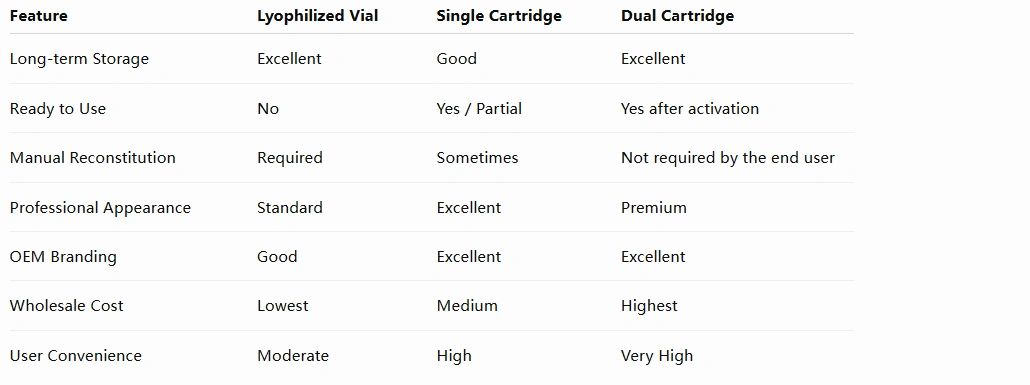
Comparison of the Three Systems
Which Products Benefit Most?
Retatrutide
Retatrutide is one of today’s most sought-after research peptides.
Because peptide integrity is an important consideration during storage and transportation, many distributors prefer either lyophilized vials or cartridge-based systems depending on their market strategy.
BPC-157 & TB-500
These recovery-focused research peptides are frequently supplied in:
- Lyophilized vials
- Single cartridges
- Dual-cartridge pens
OEM brands often select cartridge systems to improve convenience and product presentation.
Glow Blend 70 mg
Glow Blend combines:
- GHK-Cu
- BPC-157
- TB-500
Because multiple peptides are incorporated into one formulation, maintaining formulation quality during storage is particularly important. Cartridge systems offer an attractive premium presentation for private-label brands.
MOTS-c
MOTS-c has become increasingly popular in metabolic research.
Both lyophilized vials and cartridge systems are widely used depending on customer requirements.
NAD+
NAD+ products are available in several delivery formats, including traditional lyophilized vials and cartridge systems. Selection depends on storage, handling preferences, and commercial objectives.
Choosing the Right Format for Your Business
For research suppliers and distributors:
Lyophilized vials remain the most economical solution for bulk purchasing and global distribution.
For clinics and premium private-label brands:
Single-cartridge systems provide a more convenient and professional user experience.
For companies seeking a high-end product offering with enhanced convenience and premium positioning:
Dual-cartridge technology represents an advanced delivery platform that combines long-term storage advantages with simplified preparation.
OEM & Private Label Manufacturing
At RetatrutideSupplier.com, we manufacture multiple peptide delivery formats to meet different market needs, including:
- Lyophilized peptide vials
- Single-cartridge systems
- Cartridge kits with sterile diluent
- Pre-filled research pens (where applicable)
- Custom peptide formulations
- Private-label packaging
- OEM manufacturing
- Batch-specific COA documentation
- HPLC verification
Our product portfolio includes:
- Retatrutide
- BPC-157
- TB-500
- Glow Blend 70 mg
- GHK-Cu
- NAD+
- MOTS-c
- Additional research peptides
These products are supplied for research purposes with batch documentation and wholesale/OEM support.
Conclusion
There is no single delivery format that is ideal for every application.
- Lyophilized peptide vials continue to offer outstanding stability and cost efficiency for research and wholesale distribution.
- Single-cartridge systems improve convenience and create a more polished commercial presentation.
- Dual-cartridge technology combines the storage advantages of lyophilized peptides with simplified preparation, making it an attractive option for premium peptide brands.
As demand for advanced peptide delivery systems continues to grow, manufacturers capable of producing all three formats are well positioned to support distributors, clinics, and private-label partners worldwide.