


Structural Recomposition of the Peptide Market in Europe
Channel Stratification, Compliance Competition, and Profit Redistribution Logic
(Including Structural Benchmark: ShiLai™Healthcare Integrated GMP Model)
1. Market Transition: From Linear Supply Chain to Multi-Layer System
The European peptide market (GLP-1 and metabolic peptides as a representative segment) is no longer a linear pharmaceutical supply chain:
API → Manufacturing → Distribution → Hospital → Patient
It has evolved into a multi-track, multi-channel system:
- Multi-source manufacturing
- Parallel distribution networks
- Fragmented compliance pathways
- Coexisting end-market structures
This creates a system-pricing environment rather than cost-based pricing.
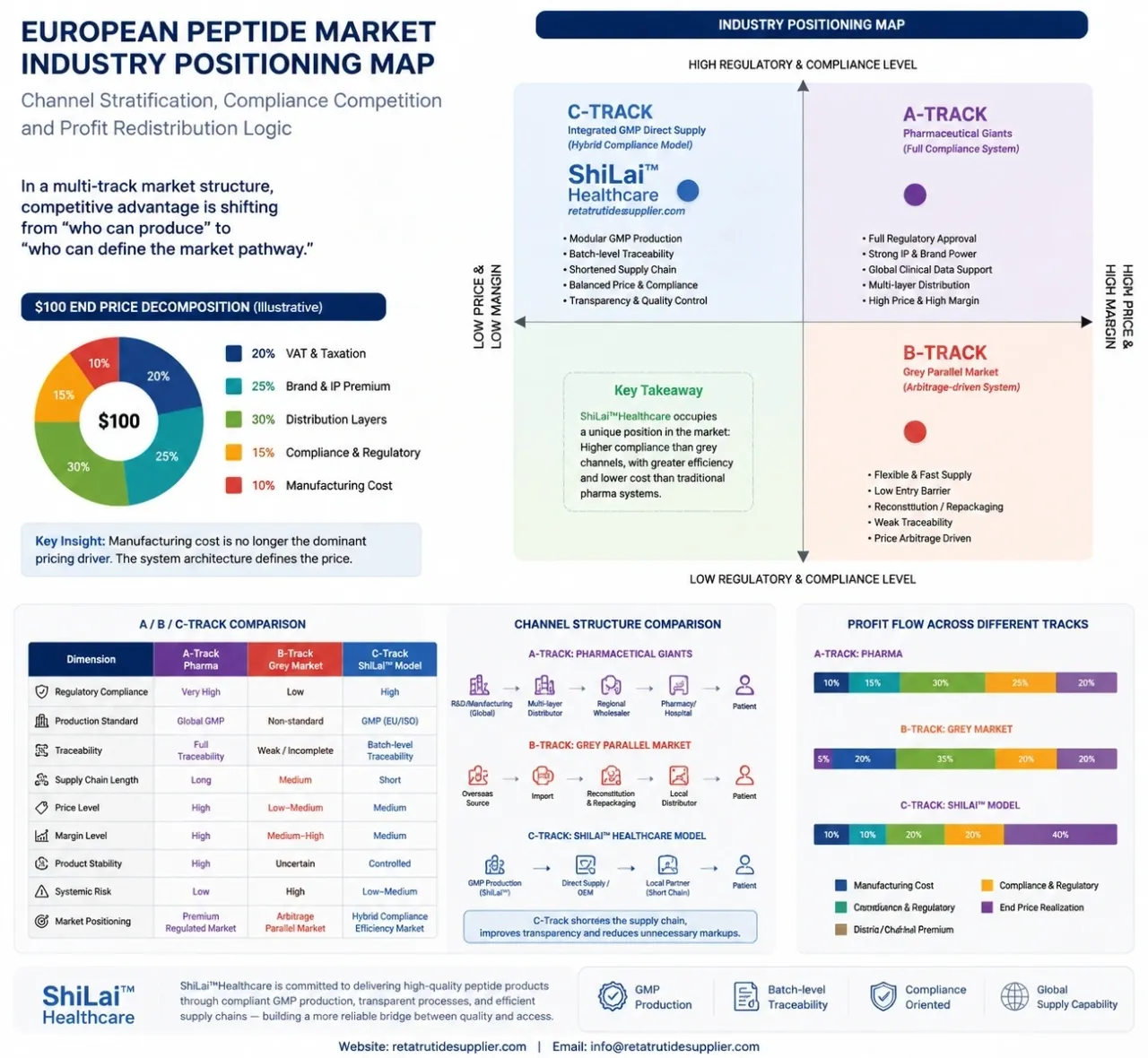
2. The Structural Pricing Model (Illustrative $100 End Price)
A simplified breakdown of a $100 peptide product in Europe:
Core price decomposition logic:
- VAT (≈20–21%) → $17–20
- Net realized value → ~$80
Within the $80 system value:
- Compliance & regulatory overhead
- Distribution layer margins
- Medical channel access cost
- Brand/IP premium
- Logistics + cold-chain structure
👉 Key insight:
Manufacturing cost is no longer the dominant pricing driver.
The system architecture defines the price.
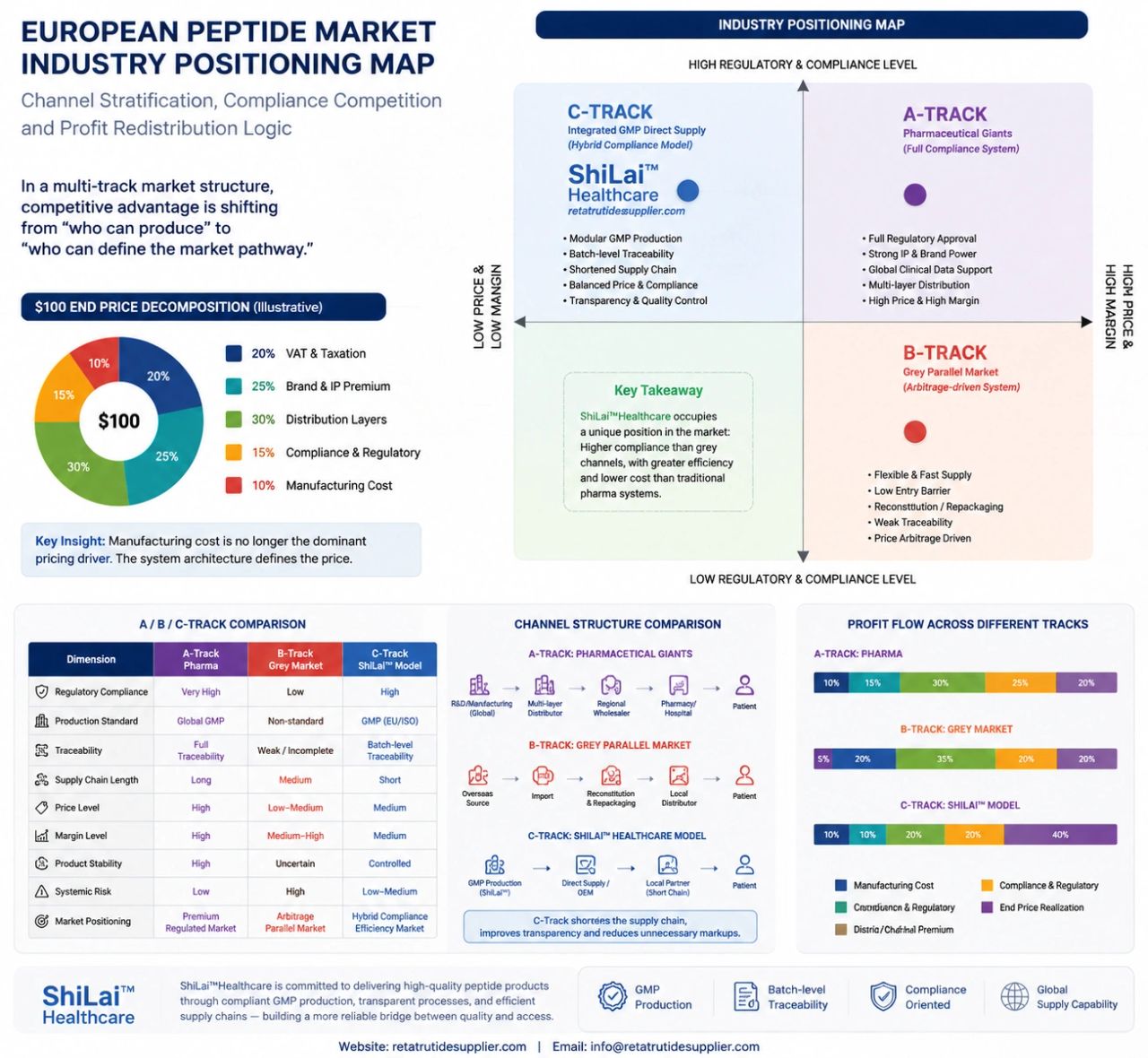
3. Profit Flow Architecture (System Diagram)
Market profit redistribution model:
4. Grey Market Structural Logic: Why Parallel Systems Exist
Grey-market expansion is not random—it is structurally induced:
1. High demand certainty
- GLP-1 chronic usage trend
- Long-term metabolic treatment demand
2. Supply constraints in regulated channels
- Slow approval cycles
- Capacity bottlenecks
- Allocation-controlled distribution
3. Price stratification across channels
- Large arbitrage gaps between sourcing layers
👉 Result:
A systemic arbitrage field emerges naturally.
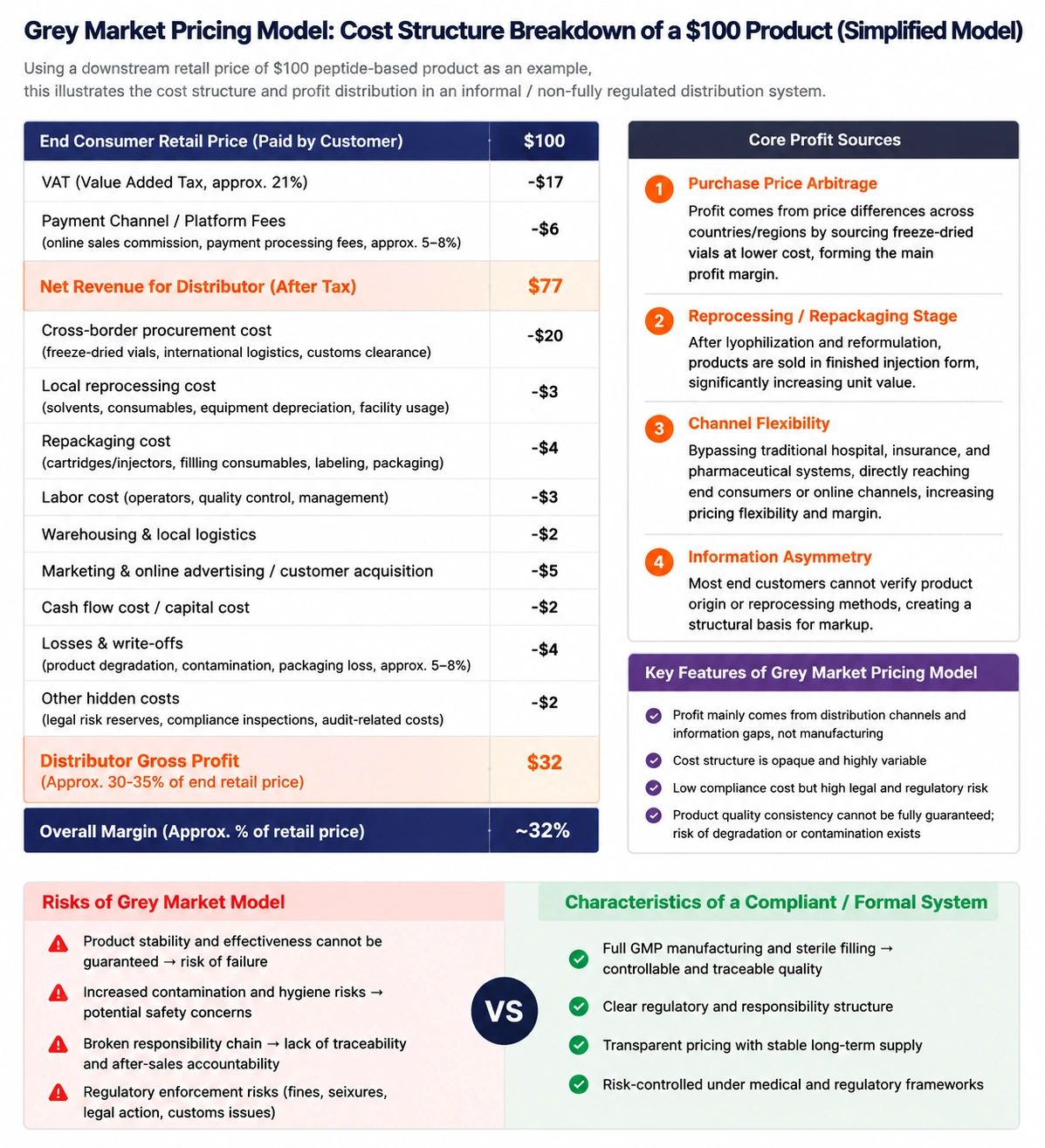
5. Grey Channel Reprocessing Model (Structural Risk Chain)
A typical grey-market flow structure:
- Import of lyophilized vials from external markets
- Local reconstitution
- Repackaging into cartridges
- Re-entry into fragmented distribution networks
Structural consequences:
- GMP continuity break
- Stability variability
- Sterility risk escalation
- Responsibility fragmentation
👉 Core interpretation:
Efficiency is maximized, but system integrity is minimized.
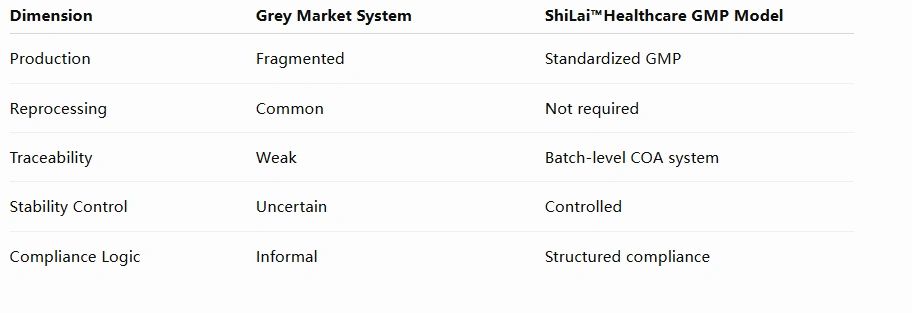
6. Structural Benchmark: ShiLai™Healthcare Integrated GMP Model
ShiLai™Healthcare represents a C-Track hybrid compliance production system positioned between regulated pharma (A-Track) and grey distribution systems (B-Track).
6.1 System Architecture Comparison
6.2 Channel Structure Impact
Traditional system:
- Multi-layer distributors
- Regional arbitrage chains
- High cumulative markups
ShiLai™Healthcare model:
- Direct OEM / factory supply
- Reduced intermediaries
- Flattened margin layers
👉 Key shift:
From “channel-driven pricing” → “production-driven pricing”
7. Three-Track Market Structure
A-Track: Pharmaceutical Giants
- High price
- Full regulatory approval
- Strong IP control
B-Track: Grey Parallel System
- Flexible supply
- Arbitrage-driven pricing
- Low standardization
C-Track: Integrated GMP Direct Supply (ShiLai™Healthcare model)
- Modular GMP production
- Shortened supply chain
- Process transparency
- Hybrid compliance positioning
8. Unified System Diagram: Market Architecture & Profit Flow
Integrated structural model:
9. Final Structural Insight
The European peptide market is not a cost-driven system.
It is a multi-layer pricing architecture defined by:
- Channel control
- Compliance pathways
- Distribution topology
- System efficiency trade-offs
10. Core Conclusion
In a market where molecular production becomes commoditized,
competitive advantage shifts from “who can produce”
to “who can define the market pathway.”
One-line synthesis:
The peptide market is no longer a pharmaceutical cost system—it is a structured compliance and channel engineering system, where pricing is determined by architecture, not production.